NEUROCARE
brain . mind . body integrative health
NEUROCARE NeuroLab
NeuroLab is the NEUROCARE initiative offering Patients suffering Neurological illness state-of-the art Neurophysiological laboratory tests in order to confirm or clarify clinical diagnosis.
Electro-encephalogram (EEG, 24-h EEG), nerve conduction studies (NCS) and Electro-myography are all laboratory tests performed by technicians and technologists for the specialist interpretation by a Neurologist.
In isolation, or not interpreted in context by a specialist Medical Doctor these tests are often misleading, which in turn may have serious consequences.
NeuroLab offers specialist level Neurophysiological investigation conducted under supervision and reported by our specialist Neurologists.
Our services include quality routine EEG testing, 24-hour EEG available on Medical Aid, nerve conduction studies (NCS) and comprehensive muscle examination (EMG).
Electroencephalogram (EEG)
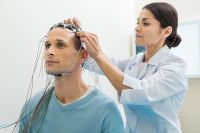
An electroencephalogram measures the electrical activity of the outside surface of the brain.
Small metal discs are placed all over the scalp with gel in order to conduct electricity via wires to a recording device - the procedure is completely non-invasive, painless and except for longer recordings easy to endure.
The result is a recording demonstrating wave lines as the electrical activity of the brain changes over time.
EEG is helpful to identify and quantify a variety of conditions in Neurology, most notably helping to confirm epilepsy, but also to assess brain damage or improvement after brain injury, recent brain surgery or stroke.
In older adults it may help to confirm delirium (medical confusion), or screen for toxic exposure or medication side-effects.
In children or young people again it helps to eliminate the many different forms of epilepsy, but often proves vital to identify over-stimulation to medication such as stimulants used in the treatment of Attention Deficit.
Short screening EEG examinations (often called "routine" EEG), typically takes 30 minutes to conduct and generally takes place at out-patient venues.
Longer 24-hour EEG examinations should only be requested by specialist Neurologists with good clinical reason and then performed by way of overnight admission to hospital in order to secure good quality recordings.
Longer recordings are generally fully sponsored on Medical Aid only when motivated and conducted by a Neurologist.
Nerve conduction studies (NCS)
Nerve conduction studies are specialized laboratory tests performed by a Neurologist, or in some cases a Technologist, to confirm or understand very specific nerve damage related pathology.
Again this test is meant to be critically considered in the clinical context of the Patient as interpreted by a specialist Medical Doctor, ideally a Neurologist.
A nerve conduction study measures the speed and efficacy with which an electrical impulse travels down a nerve. As such a small electrode sends an impulse down the nerve, and recording electrodes placed at different places down the nerve measures whether there are any delays or blockages, implying where the nerve is damaged or compressed.
As such nerve conduction studies are helpful to confirm the presence of peripheral neuropathy (nerve damage), identify compression syndromes (the nerve being "squashed" somewhere), to differentiate between nerve disease versus muscle disease, or in the confirmation of illnesses such as motor neuron disease.

Electromyography (EMG)
Electromyography is a laboratory investigation considering the presence or absence of any muscle disease.
The procedure involves essentially placing a small needle in an affected muscle further to measuring the electrical activity in the muscle in rest or when contracting.
In this way the Neurologist will be able to state whether the muscle is perfectly healthy, or being affected by a muscle disease process, or even whether the nerve supplying the muscle is doing so adequately.
EMG is indeed a most helpful tool to confirm the diagnosis of muscle disease, the extend of trauma and importantly what should be expected from recovery.
Neurophysiological examinations performed by Neurologists often prevents unnecessary operations, or help critically in determining the most correct course of action required.